Electronic Music: A 50-Year Journey

Music always fascinated me. It was like a magnet, drawing me close. As a child, I remember looking longingly at a piano, wishing I had one and could take lessons. My family had neither the room for a piano nor the money to buy one, much less pay for lessons.
When I turned eighteen, I moved out on my own. One of the first things I did was buy a piano for $200. I took a few lessons, but my efforts never amounted to much beyond giving me great enjoyment. Still, the desire to make music never left me.
Around 1975, I ended up in Seattle and discovered an electronic music cooperative called Soundwork that was open to the public. I joined and learned to use a Buchla synthesizer, one of the earliest modular instruments. It was a beast, and it didn’t even have a keyboard. The circuits were analog, and you needed an intimate understanding of frequency and amplitude modulation, along with a host of other devices for creating and shaping sound.

The sessions I spent in the studio felt almost meditative. I would turn knobs, patch cables from one module to another, and listen as the sound slowly evolved. Because the circuits were analog, they drifted slightly, giving every piece an aleatoric, unpredictable quality. No two performances were ever exactly the same.
Occasionally, one of my creations would be played at concerts featuring Soundwork artists. I enjoyed the experience, but I was not classically trained, and I began to feel that I needed that background in order to legitimize my work.
After a year of conventional music study — community college courses, private lessons in conducting, composition, and choral work — I went to the University at Albany to study with Leonard Kastle, a traditional composer, and Joel Chadabe, a pioneer in electronic music. It was fascinating to have a foot in each world.
Joel encouraged experimentation and welcomed new ideas. He brought in artists such as Pauline Oliveros and the Steve Reich Ensemble, and his studio housed a Moog synthesizer built by his friend Robert Moog. Like the Buchla, it was a massive modular system with cables everywhere. Sometimes I felt like an old-fashioned telephone operator, plugging connections from one place to another, trying to coax sound into existence.

Leonard Kastle, on the other hand, was firmly rooted in the classical tradition. He could be opinionated, but his knowledge was extraordinary. His teacher’s teacher’s teacher had been Johannes Brahms, and Leonard took pride in passing down Brahms’s approach to counterpoint. Yet he was not narrow-minded. He gave me a list of one hundred must-listen-to compositions, and through that list I discovered music I might never have encountered otherwise. He guided my work in conventional composition, while Joel encouraged me to explore sound itself. (Side note: Although Kastle had compositions performed on NBC Television Opera Theater, he is best known as the writer and director of the 1970 cult film The Honeymoon Killers.)

A year later I entered graduate school at the University of Washington School of Music. I studied systematic musicology, with a minor in composition. Once again, I split my time between traditional writing and electronic music.
But by then, electronic music had entered the computer age.
Fortran. Punch cards. Tape output.
Gone was the tactile experience of turning knobs and patching cables. Now you wrote instructions, fed them into a computer, and waited. Eventually, a tape would come back with the result. There was no instant feedback, no sense of sculpting sound in real time. For me, something essential was missing.
The computer music class I took from John Rahn was where I learned to turn Fortran code into music. I don't have any of my work from that time, but this composition by John Rahn gives an idea of the state of the art at that time. Kali was written in 1986. (I sometimes wonder if Kali was a cat whose tail was pulled. Give it a listen. It has a slow start.)
At the same time, Yamaha introduced keyboard synthesizers based on frequency modulation, and electronic sounds began appearing everywhere — in rock bands, film scores, and pop music. Electronic composers started thinking more about scales and harmony again, and less about raw sound itself. I gradually drifted away from electronic music and returned to writing notes on a page.
Years later, computer notation programs appeared. When I discovered Notion, it felt revolutionary. Instead of ink on staff paper, I could write directly on the screen, edit instantly, and hear the result played back. Even more astonishing, the program included sampled sounds from the London Symphony Orchestra. They were not perfect, but they were real instruments, not beeps and blips. As a dilletante with no hope of a real performance, the result was quite satisfying.
Then one day my husband sent me a link to a composer on YouTube (Samuel Kim @samuelkimmusic) whose symphonic arrangements sounded completely real. Full orchestra, rich textures, convincing performances. How could this be? Hiring an orchestra costs a fortune.
The answer was sample libraries.
Samuel was using orchestral samples from Spitfire Audio, a company that records every note of every instrument in extraordinary detail. Their BBC Symphony Orchestra library captured not just pitch, but dynamics, articulations, attacks, and subtle variations in tone. As someone who had studied psychoacoustics, I understood what that meant. A single note is not just a frequency — it has an attack, a sustain, a decay, harmonics, noise components, and expressive variation.
Multiply that by eighty-eight piano keys, by multiple dynamic levels, by dozens of articulations — legato, pizzicato, spiccato, col legno, harmonics, and more — and the number of possibilities becomes staggering. That is what modern sampling makes possible.
While learning to use the BBC library, I took a course in composing for science fiction film from ThinkSpace Education. That is when I discovered something that felt strangely familiar.
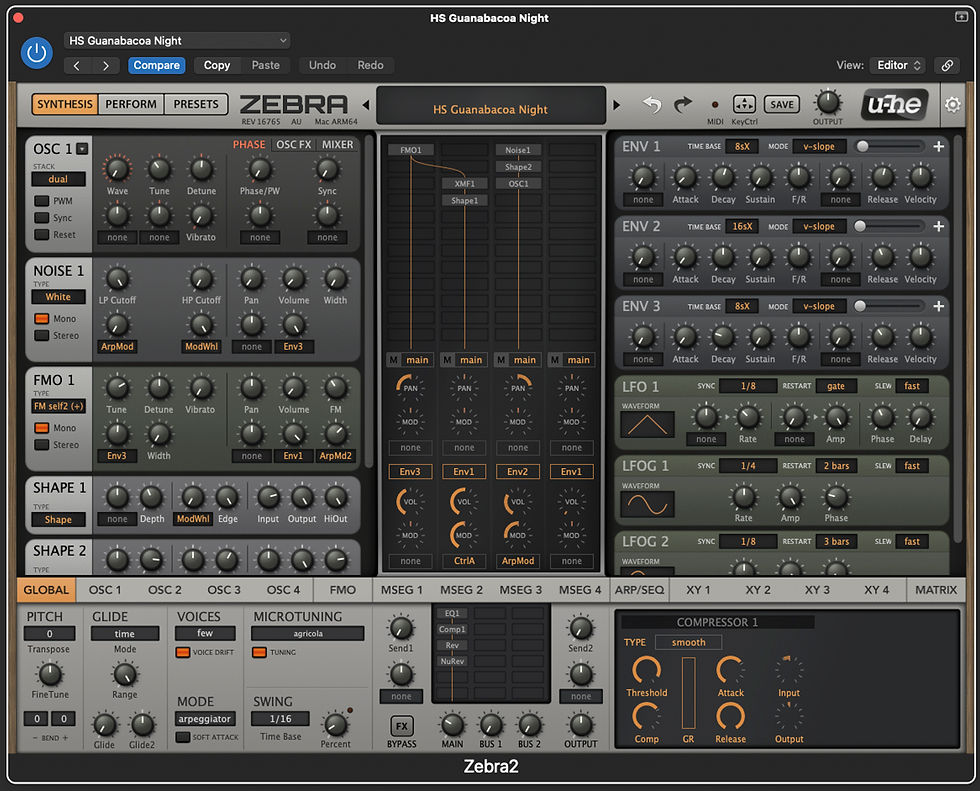
All the old synthesizers I had used in the 1970s — Buchla, Moog, modular systems — now existed again as software. On the screen I could connect virtual modules, create sine waves, sawtooth waves, and noise, and route them through filters and modulators. Instead of patch cords, I used a mouse. Instead of analog drift, I had digital precision.
But the feeling was the same.
Turn a knob. Connect a cable. Shape a sound.
After fifty years, I realized I had come full circle.
The technology had changed beyond anything I could have imagined, yet the experience was still what it had always been — the quiet, absorbing, almost meditative act of creating sound from nothing.
And that, more than anything, is what keeps drawing me back.


