The Wonderful Wildflowers of the Sierra

What's in a Name?
Perhaps there is no better time to hike the Eastern Sierra than during wildflower season. While the blooms at lower elevations in California have largely faded, the meadows and forests of the Ansel Adams and John Muir Wilderness areas are at their colorful peak. My favorite base is the rustic Reds Meadow Resort, within easy reach of some of the region’s finest trails. During this trip, I hiked to Shadow Lake, Rainbow Falls, and the Johnston Lake area.
At first, I simply planned to share a gallery of the wildflowers I photographed. But as I learned their names, I found myself asking new questions. Why isn’t Labrador Tea from Labrador? Why is Ocean Spray found in the mountains? Who put the tiger in Tiger Lily? And why would anyone call a flower Wire Lettuce? With help from Chatty (ChatGPT), I uncovered the stories behind these plants, from the origins of their names to the surprising ways they survive and support the Sierra ecosystem. I hope these little stories will help you remember the flowers as well as they have helped me.


Anderson’s Thistle reminds us that not all thistles are weeds. Unlike the invasive species that have given thistles a bad reputation, this is a native Sierra wildflower. Its striking purple blooms are a valuable source of nectar for butterflies, native bees, and hummingbirds, proving that even a spiny plant can play a vital role in the alpine landscape.
The plant honors Charles Lewis Anderson (1827–1910), an early California botanist and physician who collected many western plant specimens.

Alpine Aster lives life in the fast lane. At elevations above 9,000 feet, snow may cover the plant for nine months of the year. During the short Sierra summer, it has only a few weeks to leaf out, bloom, attract pollinators, produce seeds, and prepare for another long winter. Its cheerful lavender “flower” is actually a community of hundreds of tiny blossoms working together to ensure the plant’s survival.
Their sunny yellow centers are made up of hundreds of tiny individual flowers, while the lavender “petals” around the edge are actually separate flowers called ray florets. What looks like one blossom is really an entire bouquet working together to attract pollinators.

Despite its name, Sulphur Buckwheat isn’t the source of the buckwheat found in pancakes or soba noodles. Those come from the cultivated Asian species Fagopyrum esculentum. Sulphur Buckwheat belongs to the same botanical family but is a distinctly North American wildflower. Its bright yellow blooms are especially important to native bees and butterflies, making it one of the Sierra’s most valuable pollinator plants.

Mariposa lilies (Calochortus) begin life looking like little more than blades of grass. Their name comes from the Greek for “beautiful grass,” a fitting description for a plant that conceals one of the Sierra’s most exquisite flowers behind such humble foliage. Each blossom lasts only a few days, making every encounter feel like discovering a hidden treasure.
The flowers have evolved as landing pads for pollinators. The petals often bear intricate markings, colored glands called nectaries, and even tiny hairs that help guide bees toward nectar. What appears to us as delicate decoration is actually a sophisticated navigation system for insects.

Prairie Cinquefoil seems oddly named for a flower growing in the Sierra Nevada. The name comes from the Great Plains, where the species was first recognized as a common prairie wildflower. Yet it has adapted to a wide range of habitats across North America. In the Sierra, it finds its niche in moist mountain meadows and along streams, where the cool, sunny conditions resemble those of its prairie home.

At first glance, I mistook the Sierra Columbines for Shooting Stars. Both dangle gracefully from slender stems, inviting a double take. A closer look reveals two very different designs. The columbine’s long nectar spurs are perfectly suited to moths and hummingbirds, while the shooting star’s swept-back petals give the flower the appearance of a tiny meteor racing across the meadow. Nature found two elegant solutions to attracting pollinators, and both are among the Sierra’s most enchanting wildflowers.

Cow Parsnip is a native member of the carrot family and a close relative of the edible garden parsnip, though the two are different species. Its towering stems and broad leaves likely inspired the “cow” in its name, as the plant grows large enough to be browsed by cattle, deer, and elk. While beautiful in bloom, hikers are wise to admire it without touching, as the sap can cause skin irritation when exposed to sunlight.

Coyote Mint is a true member of the mint family, making it a cousin of peppermint, spearmint, basil, rosemary, and sage. Crushing its leaves releases a pleasant minty fragrance, although the plant’s showy flower clusters look quite different from the familiar garden mints. The “coyote” in its name likely reflects its status as a wild native of the American West rather than any special connection to the animal itself.

Common Daisy may sound like a humble name, but its history is anything but ordinary. The word “daisy” comes from the Old English dægeseage, meaning “day’s eye,” because the flower closes at night and opens again with the morning sun. It’s a reminder that even the most familiar wildflowers have stories waiting to be discovered. Despite its name, I’m sure the Common Daisy would have preferred something a bit more glamorous.

Red-twig Dogwood gets its name not from dogs but, most likely, from an Old English word for the hard wooden skewers and tools once made from its exceptionally dense wood. Over the centuries, “dagwood” appears to have evolved into “dogwood.” The “red-twig” part of the name is much easier to understand, especially in winter, when its brilliant crimson stems brighten the landscape long after the leaves have fallen.

Giant Sawgill was an unexpected find on a dry July hike. Most mushrooms wait for autumn rains, but this species grows on buried conifer logs and roots, drawing moisture from decaying wood long after the surrounding soil has dried. Its name comes from the tiny saw-like teeth lining the edges of its gills, a feature hidden beneath its broad cap.

Golden Aster is one of the Sierra’s survivors. While many wildflowers seek moist meadows, this cheerful plant flourishes in dry, rocky soil under the summer sun. Fine hairs covering its leaves help conserve water, allowing it to bloom long after many neighboring plants have faded. Even its scientific name hints at its adaptability. Heterotheca means “different cases,” a reference to the plant’s two kinds of seeds, each helping it spread in a different way.

Goldenrod earns its name from its tall, upright flowering stem, which resembles a golden rod or staff when covered with hundreds of tiny yellow blossoms. Its scientific name, Solidago, comes from the Latin for “to make whole,” a nod to its long history as a medicinal plant used to promote healing.
Goldenrod is often wrongly blamed for hay fever. Because it blooms at the same time as ragweed, many people assume it’s the culprit. In reality, goldenrod’s pollen is heavy and sticky, carried by insects rather than the wind. The real offender is the inconspicuous green-flowered ragweed blooming nearby. Goldenrod simply gets blamed because it’s the one everyone notices.

Brewer’s Mountain Heath isn’t named for a drink but for William Henry Brewer, the botanist who explored California’s mountains in the 1860s. Its delicate pink, bell-shaped flowers belie its toughness. The plant thrives in the harsh alpine environment, where snow may blanket it for much of the year before it bursts into bloom during the brief Sierra summer.

Ocean Spray isn’t named for where it grows but for how it looks. When covered with thousands of tiny white blossoms, the arching branches resemble the frothy spray of breaking ocean waves. Although common along the Pacific Coast, this graceful shrub is equally at home in the mountains, where its summer display brightens forest edges and meadows.

The original monkeyflower name referred to species formerly placed in the genus Mimulus. The word Mimulus comes from the Latin mimus, meaning actor, mime, or buffoon. Early botanists thought the flower resembled a little face making expressive or comic gestures, like a mime wearing a mask.
The common name monkeyflower probably arose because many people saw something even more specific: the blossom looks like the face of a monkey.
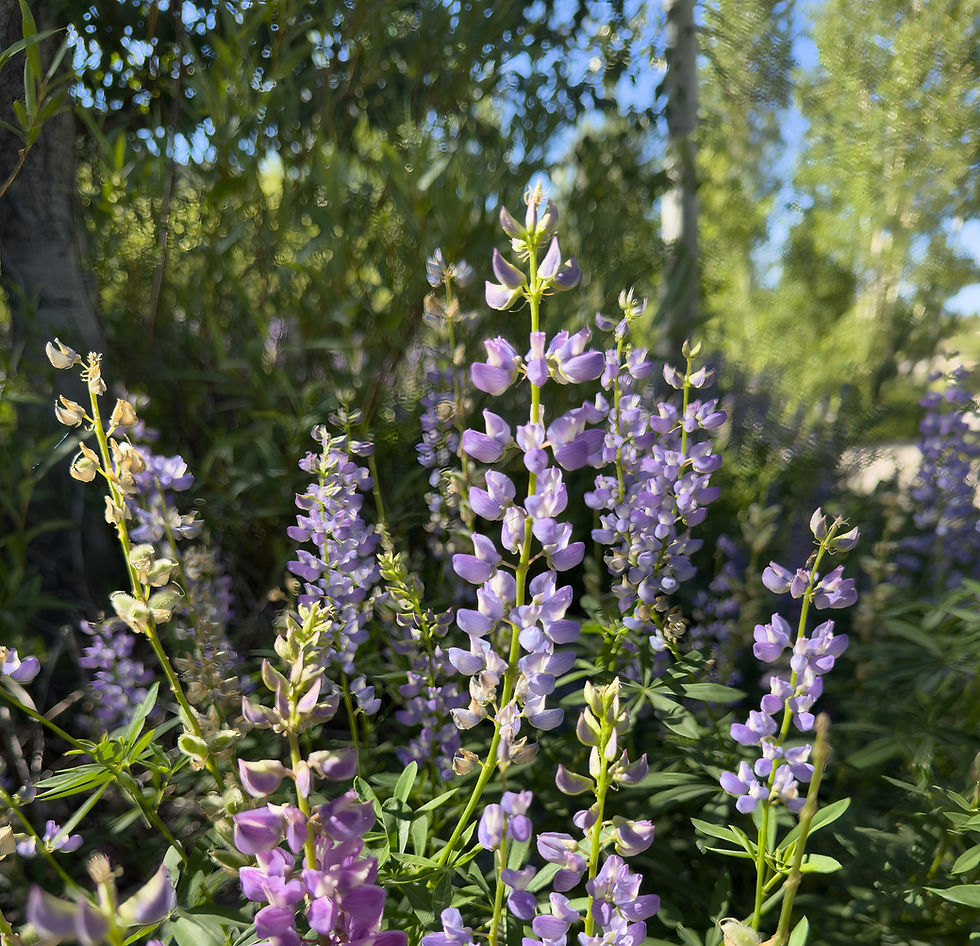
Lupines are more than just one of the Sierra’s most colorful wildflowers. Hidden beneath the soil, their roots form partnerships with nitrogen-fixing bacteria that convert nitrogen from the air into nutrients plants can use, enriching the soil for neighboring plants. Their leaves are also an essential food source for the caterpillars of several butterfly species, making lupines a cornerstone of the mountain ecosystem. Ironically, their name comes from the Latin lupus, meaning “wolf.” Ancient Romans believed lupines “wolfed down” the soil, robbing it of nutrients. Modern science has revealed the opposite. Rather than depleting the earth, lupines quietly improve it, making them one of nature’s most generous wildflowers.

Indian Paintbrush looks as though someone dipped a brush into scarlet paint and left it standing among the wildflowers. The brilliant red “brush” isn’t made of petals at all but of colorful leaves called bracts that surround the tiny flowers. The plant has another surprise hidden underground. It is a hemiparasite, producing its own food through photosynthesis while also tapping into the roots of nearby plants for water and nutrients. Beauty, it seems, can have a practical side.

Squirrels dine on pine cones at our home in the Santa Cruz Mountains, often using one of our stone chairs as a table and leaving a neat pile of discarded scales behind. So I was surprised to stop on a trail near Reds Meadow when what looked like a pomegranate caught my eye. It was actually a pine cone abandoned halfway through a squirrel’s meal. With its scales peeled back, the cone revealed brilliant reds and oranges hidden beneath its weathered exterior. I’d seen the leftovers of countless squirrel banquets at home but had never witnessed this colorful stage of the feast.
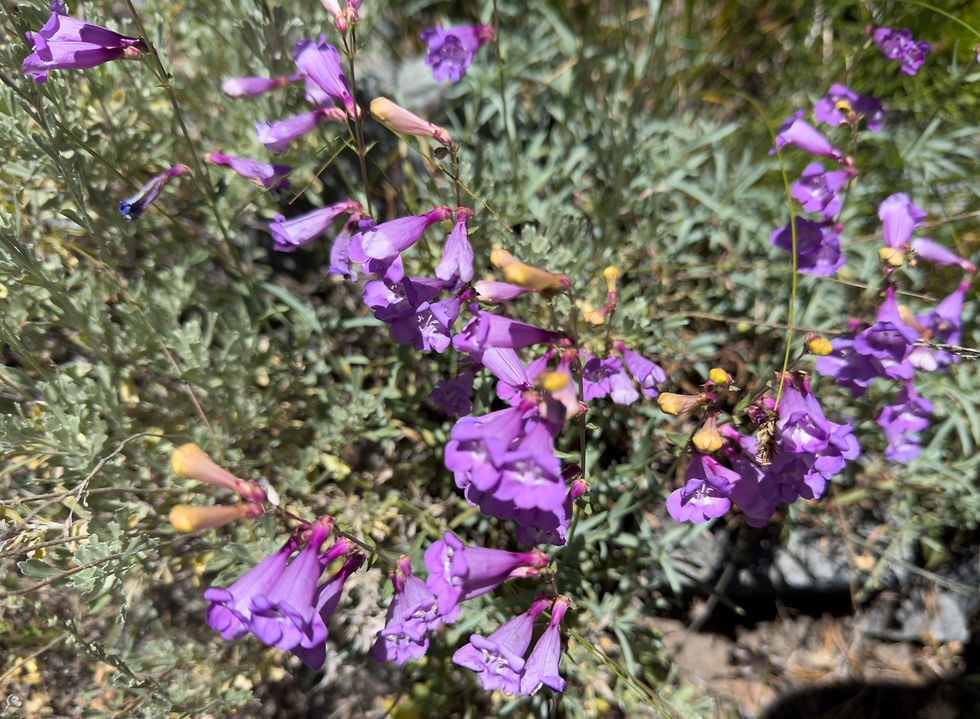
Penstemons have become one of my favorite garden plants, so I was delighted to find them flourishing along the trails near Reds Meadow. Their tubular blossoms are irresistible to bees, butterflies, and hummingbirds. The name Penstemonmeans “five stamens,” although that’s only partly true. The flower has four fertile stamens and a fifth, sterile one called a staminode. Rather than producing pollen, this “bearded tongue” helps guide pollinators to the flower’s nectar, making the name both slightly mistaken and botanically memorable.

At first, I thought these brilliant red blossoms were California Fuchsia. A closer look revealed they were Firecracker Penstemon, another hummingbird favorite. Their long, slender tubes aren’t just beautiful. They are perfectly engineered for hummingbirds, whose equally long bills and tongues can reach nectar hidden deep within the flower. Each sip rewards both bird and plant, as pollen is carried to the next blossom.

One-seeded Pussy Paws may have the most endearing name of any Sierra wildflower. The soft, rounded flower clusters resemble the tiny pads of a kitten’s paw, making it easy to see how the plant earned its common name. The “one-seeded” part is less whimsical. Each tiny flower produces a fruit containing just a single seed, a detail that helps botanists distinguish this species from its close relatives.

Ranger’s Buttons look exactly like their name suggests, with neat white flower heads resembling tiny buttons. The origin of the “ranger” in the name remains a mystery, though it likely dates back to the early days of forest rangers in the Sierra Nevada. Sometimes the most memorable wildflower names are the ones that leave us guessing.

It’s easy to see how Shooting Stars got their name. With their petals swept backward and their pointed centers aimed toward the ground, the blossoms look like tiny meteors frozen in mid-flight. No one knows who first imagined the resemblance, but the poetic name has endured for well over a century. Even the scientific name has its own story. Once placed in the genus Dodecatheon, named for the twelve Olympian gods, the flower is now classified as a primrose, though many wildflower enthusiasts still prefer its older name.

Tiger Lily earned its name from its striking orange petals sprinkled with dark spots, a pattern that reminded early botanists of a tiger’s coat. Our Sierra species, the Columbia Tiger Lily (Lilium columbianum), is a western North American native. Although many gardeners know the Asian Tiger Lily, hikers in the Sierra are treated to our own wild version, one of the mountains’ most spectacular summer flowers.

Western Labrador Tea isn’t from Labrador, at least not this species. Early explorers gave the name to a related northern shrub whose fragrant leaves were brewed into tea by Indigenous peoples. When botanists discovered similar plants in western North America, the name came along. Although the leaves of Western Labrador Tea can be brewed into an aromatic tea, modern experts recommend enjoying it only occasionally because it contains natural compounds that can be harmful if consumed in large amounts. It is actually a wild rhododendron!

White-veined Wintergreen isn’t the source of the familiar wintergreen flavor found in candies and chewing gum. That distinction belongs to a different relative, eastern teaberry. Instead, this Sierra wildflower earns its name because its evergreen leaves persist through the winter, while the striking white stripe running down each leaf inspired the “white-veined” part of its name.

Wire lettuce may not have the most inspiring name, but it is an apt one. The plant’s slender, stiff, branching stems resemble green wires, while its membership in the same botanical family as cultivated lettuce earned it the second half of its name. Its delicate pink flowers seem to float on a web of wiry stems, giving this high Sierra wildflower an appearance that’s far more graceful than its rather utilitarian name suggests.

Common Yarrow has been valued for centuries as both a medicinal and culinary herb. The leaves and flowers can be brewed into tea, while the young leaves have occasionally been added to salads and soups, though their flavor is pleasantly bitter. Its scientific name, Achillea millefolium, honors the Greek hero Achilles, who, according to legend, used the plant to treat the wounds of his soldiers during the Trojan War.

I couldn’t help wondering whether this iris was a survivor from Bodie’s mining days or a native wildflower. It turns out it’s most likely Rocky Mountain Iris (Iris missouriensis), a species that has flourished in the Sierra and Great Basin for thousands of years. Long before miners arrived in search of gold, these elegant blooms were already brightening the wet meadows around what would become Bodie.
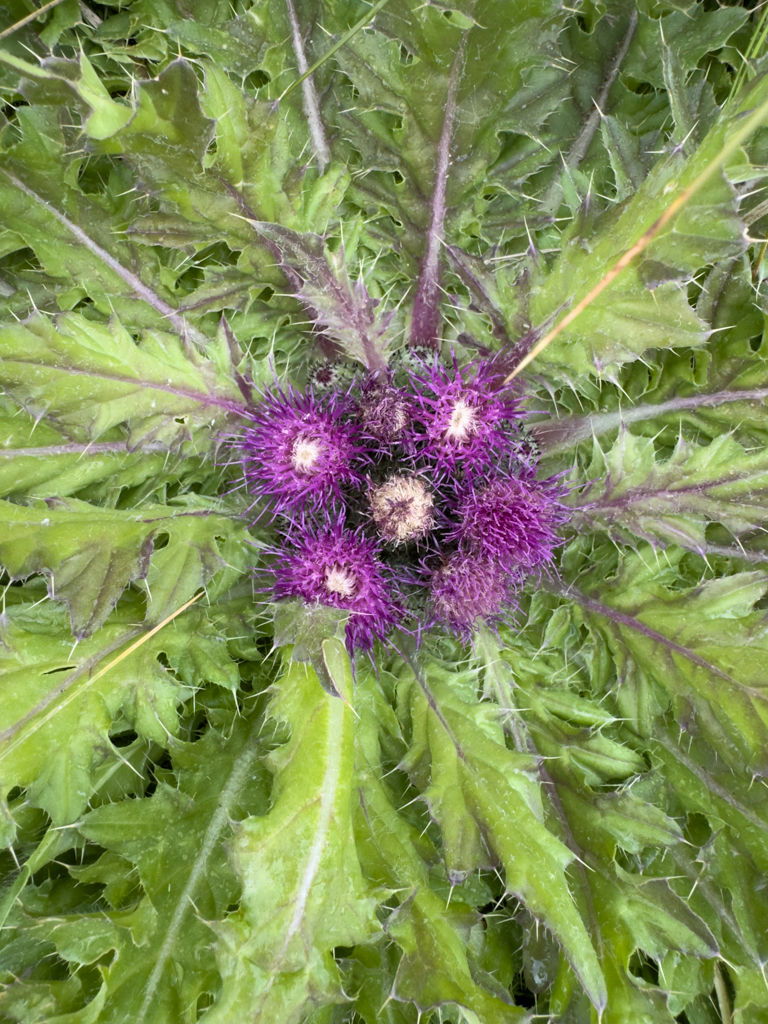
At first I thought someone had stepped on this thistle. Instead, I was looking at a species that naturally hugs the ground. In the windy, high-elevation environment of the eastern Sierra, staying low helps conserve moisture, resist the wind, and take advantage of the warmth radiating from the soil. Even a prickly thistle has learned to keep its head down.
--------------------
Unless otherwise noted, all images photographed by Bunny Laden in July 2026 at elevations between approximately 7,500 and 9,200 feet in the eastern Sierra Nevada on trails near Reds Meadows. Descriptions of plants by ChatGPT.


