Unexpected Art in the Czartoryski Museum, Kraków

I was surprised to learn that Leonardo da Vinci’s Lady with an Ermine is housed in the Czartoryski Museum in Kraków, Poland. Since the museum was only a few blocks from my hotel in Old Town, I secured a ticket.
As the museum’s star attraction, the da Vinci naturally drew most visitors. Yet I found myself lingering instead before a Rembrandt landscape. Before I even noticed the artist’s name, the interplay of light and shadow had stopped me in my tracks. It was a reminder that the best museum experiences do not always come from chasing famous masterpieces, but from letting a painting quietly ask you to stay a little longer.

Rembrandt’s Landscape with the Good Samaritan, painted in 1638 on an oak panel, is one of only six surviving landscapes by the artist. At first, I thought part of the painting was backlit. The longer I looked, however, the more I appreciated Rembrandt’s extraordinary command of light. Brilliant sunlight gives way to deep shadow, while tiny, almost hidden figures gradually reveal the familiar biblical story of the Good Samaritan.


Before reaching the da Vinci, I spent time admiring the museum’s impressive collection of mosaics. Shown here is an eighteenth-century portrait mosaic of Saint Peter holding the keys to heaven, created in 1755 by the Russian polymath Mikhail Vasilyevich Lomonosov using thousands of tiny glass tiles.

On the left is The Birth of the Virgin, painted by an unknown Kraków master in the early sixteenth century. The work combines a medieval religious narrative with increasingly Renaissance-inspired architecture and more individualized figures. The tiny kneeling figures and the family coat of arms in the foreground identify the patrons who commissioned the painting.

On the right is The Annunciation, painted by Master Jerzy in 1517. It originally formed the central panel of a triptych in St. Michael’s Collegiate Church on Wawel Hill. Princess Izabela Czartoryska rescued it from the ruined church in the early nineteenth century, preserving what is now regarded as one of the masterpieces of late Gothic painting in Poland.
Finally, I reached Leonardo’s Lady with an Ermine. The museum was pleasantly uncrowded, allowing me to sit quietly and study the painting for quite some time. It is one of only four surviving portraits by Leonardo da Vinci, and seeing it at leisure was a privilege.
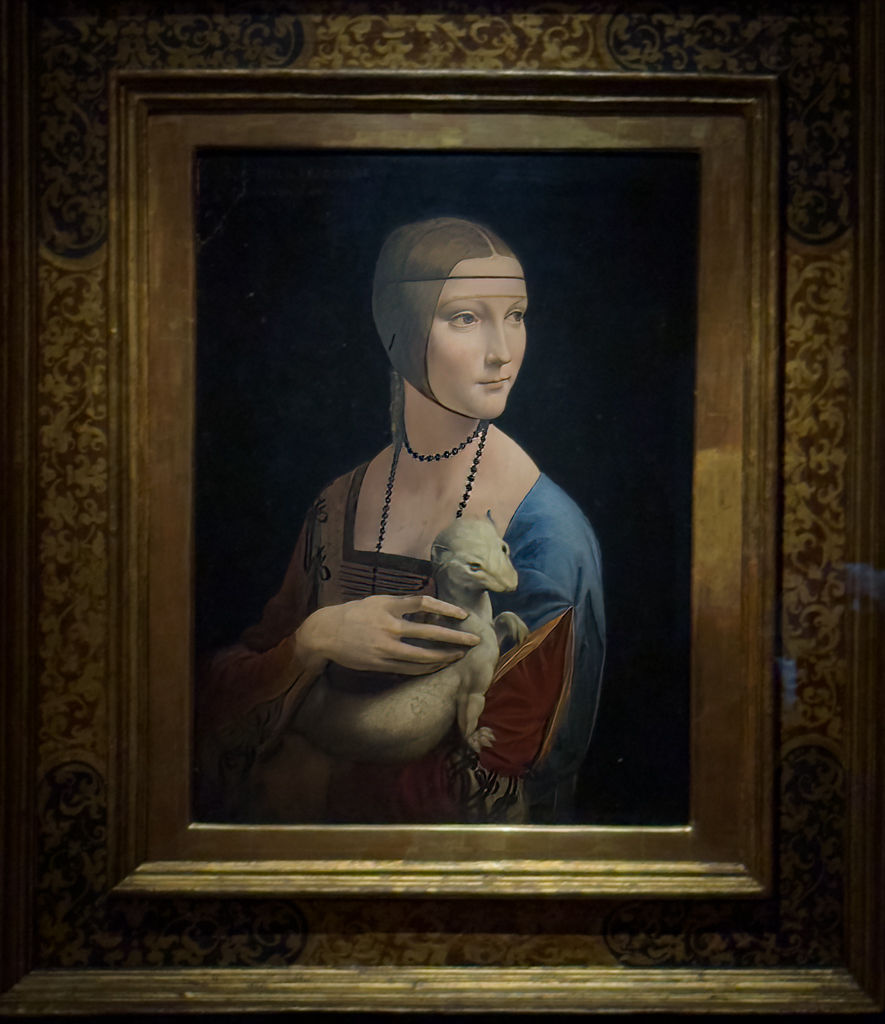
The young woman is generally accepted to be Cecilia Gallerani, one of the best-educated women at the court of Milan. She was only about sixteen when Leonardo painted her around 1490. Cecilia was the mistress of Ludovico Sforza, Duke of Milan, and the ermine carries several layers of meaning. Ludovico belonged to the prestigious Order of the Ermine, making the animal one of his personal emblems.
Many art historians also see the ermine as a subtle reference to Cecilia’s relationship with the Duke, while others note that the Greek word for ermine, galē, echoes her surname, Gallerani. Like much of Leonardo’s work, the portrait invites viewers to ponder several meanings at once.
Although Leonardo’s Lady with an Ermine is the museum’s greatest treasure, I left equally impressed by Princess Izabela Czartoryska’s (1746 to 1835) remarkable vision. She was not simply collecting beautiful objects. During a time when Poland had disappeared from the map of Europe, she set out to preserve its cultural heritage for future generations. Her collection of paintings, manuscripts, books, weapons, armor, flags, and decorative arts tells the story of a nation as much as the story of its artists. The Leonardo may draw visitors through the door, but the collection itself is what makes the museum unforgettable.


