The People Behind Our Rotary Partnership

Updated: Jul 22
During my three-week trip through Poland, several experiences stood apart from all the others. They involved getting to know members of the Rotary E-Club of Poland and visiting two schools in Suwałki that serving children and young adults with Autism Spectrum Disorder (ASD) and other neurodevelopmental challenges.
The Rotary E-Club of Poland partnered with the Rotary Club of San Jose to support two schools in Suwałki, Poland, and two more in Berdychiv, Ukraine. The visit gave me an opportunity to see firsthand how an international Rotary partnership can change lives.
A Small but Mighty Club
The Rotary E-Club of Poland has only ten members, but they have the energy of a club ten times its size. Their members live in cities including Kraków, Warsaw, and Gdynia, so they meet primarily online. Despite the distance, they get things done.
Over the course of the trip, I had the pleasure of getting to know three members of the club: Monika, Anita, and Kuba. Monika, who coordinated much of our project with the Rotary Club of San Jose, graciously arranged our visit to Suwałki. Past President Anita's warmth made our dinner in Warsaw feel like old friends catching up. Kuba was the ultimate Tri-Cities tour guide, with a story behind every place he showed us.

A Visit to Suwałki

Suwałki is isolated in the northeast corner of Poland. It is known for the Suwałki Gap, the only land route between the Baltic states and the rest of the European Union. Given its strategic location near Lithuania and the Russian exclave of Kaliningrad, I expected Suwałki to feel tense. Instead, I found a city of parks, trees, and quiet neighborhoods. It was hard to imagine a more peaceful place.
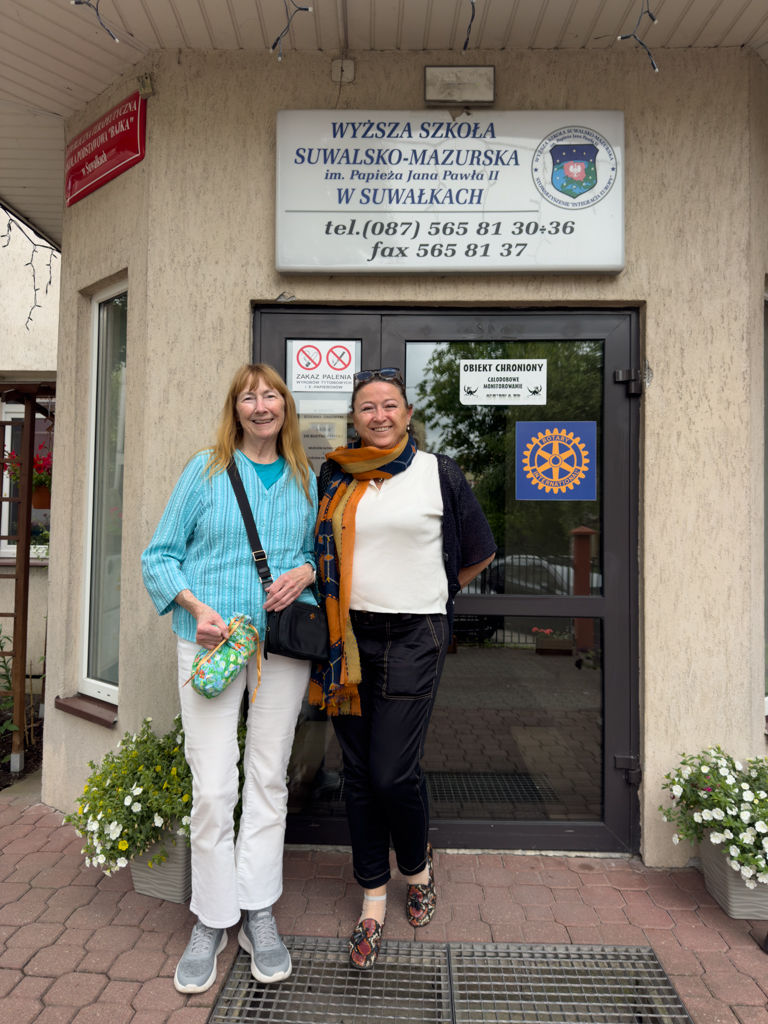
The two Suwałki schools together serve 250 students. The schools sit on the edge of Suwałki, away from the noise of the city. They are in peaceful settings where children who often struggle with sensory overload can learn and grow.

Our first stop was Bajka, a therapeutic school serving young children with developmental disabilities. The emphasis is on early intervention, with education and therapy integrated throughout the day. Bajka translates as “fairy tale” and the school is often referred to as a kindergarten. However, it's much broader than what we think of as kindergarten in the United States.


When I walked in the door, the school was buzzing with energy. Children were finishing lunch, cleaning up, and preparing for afternoon activities. We were escorted to the top floor, where Renata, Beata, and several other staff welcomed us with coffee, cakes, and enormous smiles.
The conversation was in Polish, with Monika translating. As Renata enthusiastically described the school's programs, I wondered how Monika could possibly keep up with the translation. Somehow she never missed a beat. After our visit to the office, Renata and Beata proudly showed us most of the rooms in the building. As we toured the classrooms and therapy rooms, one thing impressed me above all else: the extraordinarily low therapist-to-student ratio.

Children receive therapy in very small groups, allowing each child to receive highly individualized attention. Bajka also has an after-school program, which we visited. There I learned that some of the children are non-verbal.

A highlight of the tour was to see the two newly renovated rooms that were created for large group activities, community gatherings, and staged events. The District Grant through Rotary Club of San Jose helped to purchase much of the equipment, including sound panels, texture pads, soft seating, colorful blocks, an electric piano, and more. A moveable wall between the two spaces allows flexibility to seal off the rooms or enjoy a larger space.


Prolog School
Our next stop was Prolog. By the time we arrived, the school was finished for the day. We were able to meet one young man who was in the office when we arrived. His talent was podcasting. Toward that end, he won a local contest, sponsored by a bank, where the prize was equipment for a proper podcasting studio in the school. We toured the studio and watched an episode of him interviewing another student. I was impressed.
What struck me most was that Prolog doesn't define students by their disabilities. Instead, it helps them discover talents and build practical skills. The students can attend therapy sessions, pursue academic studies as well as a wide variety of vocational activities. Prolog has specialized classrooms for ceramics, computing, model making, sewing, and machine shop skills. Even the on-site kitchen serves as a learning environment.


The Art Café
A point of pride, particularly for the Polish Rotary club, is the coffee shop they helped to set up in one of the city municipal buildings. The Rotary E-Club purchased an industrial espresso machine. Prolog teaches students all the skills needed to be a barista. When there is an event in the municipal building, the café opens, thus allowing students to get work experience. It is quite a nice space.


A Surprise Gift
We returned to Bajka School, now quiet with school in recess, where the Renata and Beata presented each of us with a beautiful sękacz, a traditional spit cake. Then they insisted we look inside. Hidden in the center was a bottle of homemade berry liqueur with an equally delightful label:
"The centuries-old tradition of distilling homemade spirits, begun around 1821 and perfected by successive generations, has given rise to the product you now hold in your hand. It was created from the finest ingredients, gathered in the inaccessible depths of the Białowieża Forest, beyond the reach of ordinary mortals."

Whether the berries truly came from the mythical depths of the forest or simply from someone's favorite patch, I'll never know. Either way, we laughed, thanked our generous hosts, and carried our fragile treasure very carefully down three flights of stairs.

The Dream

I thought the tour was over, but Renata insisted that we follow them to see a parcel of land that was gifted to the school. Standing in an empty field, I had to summon my imagination. Renata and Beata needed no such effort. They already saw apartments where former students could live independently and a day center where adults with ASD could continue learning long after they aged out of the school system. I hope one day to return and see their dream fulfilled.

The Tri-Cities
My dear friend Ewa lives part time in Warsaw and part time in Seattle, which is where I met her decades ago. Ever since she told me that her home town is Gdynia, on the coast in Northern Poland, I’ve wanted to visit. Gdynia is part of the Tri-Cities area, with older Gdańsk and the posh Sopot making up the other two. When Rotary member Kuba heard I had booked several nights lodging in Old Town Gdańsk, he insisted on giving us a tour of his stomping grounds.

Kuba met us at our hotel one morning, walked us through Old Town, and then whisked us off in his car to see some of his favorite places, including one I never would have found on my own. We, ate hearty fish soup on the waterfront, drove past Lech Wałęsa's home, and wandered past Sopot's delightfully crooked Crooked House. One of my favorite stops was a collection of whimsical yet haunting steel sculptures by Czesław Podleśny, assembled from scrap metal salvaged from the shipyards. It was exactly the sort of hidden gem that only a local would think to share. When our legs finally needed a rest, Kuba introduced us to his favorite independent coffee shop. What a day!

Rotary at its Best
Before this trip, the Rotary E-Club of Poland was simply the name of an international partner. By the end, it had become a group of friends whose dedication to children with ASD left a lasting impression on me. Everywhere we went, the focus wasn't on buildings or equipment. It was on giving each student the greatest possible independence.
Poland gave us magnificent castles, beautiful cities, remarkable museums, and unforgettable meals. Yet when I think back on the trip, my mind returns first to the therapists in Suwałki and the Rotarians who quietly make their work possible. That's Rotary at its best.


